
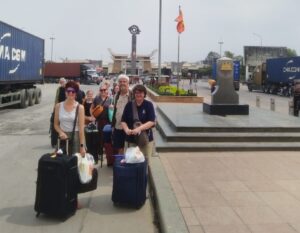
 It is stiflingly hot and humid. The midday tropical sun exerts an almost physical pressure. Our bus has let us off on the Vietnamese side of the border, where we get our passports stamped. Now we have to haul our suitcases across a sort of parking lot no-man’s-land to the Cambodian side. Physically, it’s a distance of about a hundred meters. But in other ways the gulf is much wider. Fair warning, you made find the rest of this post tough to read.
 Cambodia is among the poorest countries in SE Asia. Simply put Cambodia is still recovering from its brutal history – French colonialism, American bombing, fighting with the Vietnamese and most of all the internal genocide carried out by the Khmer Rouge. The toll of death and suffering is staggering. I have come to think of Cambodia as “the Land of Tears”.
And yet, Cambodia is also a vibrant, culturally rich and fascinating country on many levels, so let me back up a bit.
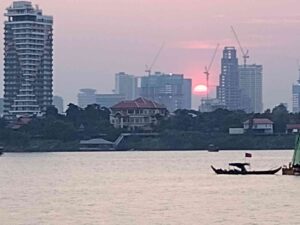 The fighting ended in Vietnam in 1975. It carried on in Cambodia until 1993. During that time Cambodia lost almost half its population. So development wise, Cambodia is where Vietnam was 25 or 30 years ago. But investment is now pouring in from China, Korea, Japan and elsewhere. The skyline of Phnom Penh, the capital, is studded with skyscrapers and dozens of cranes are building more. Tourists are also discovering Cambodia, as neighbouring Thailand and Vietnam become increasingly crowded. And why not? With archeological wonders like Angkor Wat, beautiful beaches, an amazing if sometimes troubling history and warm friendly people, Cambodia has a lot going for it.
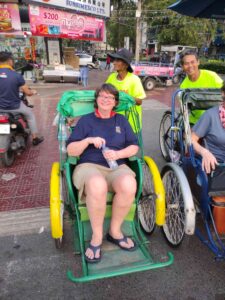 We arrive in Phnom Penh is the late afternoon. After checking in to our hotel, our group takes a short walking tour of the old quarter, with its French colonial buildings and market. From there we load into cyclo’s for a sunset tour of the city’s major landmarks. The cyclo is basically a tricycle rickshaw. It feels a bit exploitive, but our guide, Sarou assures me it provides good jobs and keeps an old tradition alive. It’s also very comfortable. As one of the Brit’s in our group muses, “So this is the future – a care home outing.”
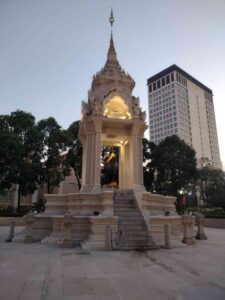
 We are whisked around the Independence monument, the Constitutional monument, the Royal Palace and other sites. Though Phnom Penh’s traffic is slightly less crazy than other parts of SE Asia, the cyclo still feels a little vulnerable. But the drivers are amazing, parting traffic, like Moses at the Red Sea.
The next morning we confront Cambodia’s brutal history directly. We are taken first to the S-21 detention and interrogation center, one of numerous such centers throughout the country. This one has been preserved as a Genocide Museum.
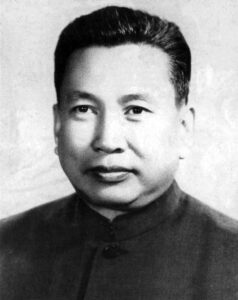 Pol Pot, head of the Cambodian Communist Party, or Khmer Rouge as they came to be known, took control of the country in 1975. His stated goal was to create an idealized agrarian society. To do so he believed he needed to eliminate everything that had gone before – not just institutions, but people too. Government officials, intellectuals, doctors, lawyers, teachers, indeed anyone with more than a rudimentary education needed to be eliminated. They were first sent to centers like S-21 where they were tortured into confession, and then shipped to the so-called “killing fields” for elimination. Like most such purges, the paranoia eventually turned inward and many thousands of party cadres were also killed.
In 1979 the Vietnamese invaded and toppled the Pol Pot government. But the Khmer Rouge retreated to the jungle and kept on fighting until 1993. By the time it was all over, just under half, almost 3 million of Cambodia’s total population of 7 million people were dead from combat, starvation, disease, but mostly by extermination. Among them were the best and the brightest.
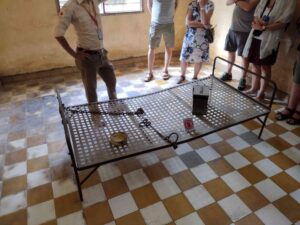 S-21 is a former secondary school. One its most chilling features is its seeming banality. On the outside you see only a few strands of barbed wire and bars on the windows. Inside you see where the former classrooms were divided up into tiny cells. There are still blood stains on the floor. Display cases house the implements used during interrogations. Rows of photographs of inmates stare back from the walls – the Khmer Rouge were methodical about documenting their victims and their “confessions”. There are children and babies among them, because the Khmer Rouge wanted to purge any possible resistance, root and branch.
 There is little conversation as we confront these exhibits.
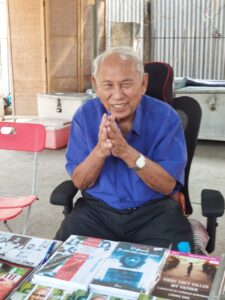
Over 20,000 people passed through S-21. Only 8 adults and 4 children survived. We meet two of them Chum Mey and Bou Meng. Mey survived because he was a mechanic and could fix things. Meng was an artist and drew portraits of Pol Pot for the Party. Both have written books about their ordeal. I bought them both, though I have not yet brought myself to read them. Mey smiles up at me as he signs my copy. I press my hands together and bow – a traditional Buddhist greeting. I’ve done it countless times on this trip, as a courtesy. This time I do it with the utmost reverence.
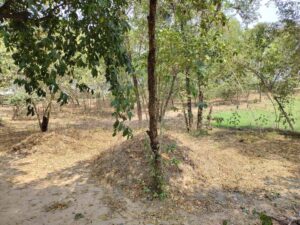 From S-21 we drive a short distance out of the city to Choeung Ek, the best known of aproximately 300 “killing fields” scattered around the country. Most of the original buildings have rotted away or been torn down. They were little more than sheds anyway. There are simple walkways and signs amid the pits where the bodies were buried in mass graves. 8,895 bodies have been exhumed. There are thousands more, but it has been decided to leave them be.
 A Buddhist stupa has been built in the center of Choeung Ek, as a memorial. It houses over 5,000 skulls, most shattered or smashed in. The killing was done with pickaxes and clubs, because bullets were expensive. Dead is dead, but the hands-on nature of it and the scale of the killing seems especially savage.
It’s tempting to try to explain it all away – it was done by “those” people; they’re different from us. But that’s simply not true. From Cambodia, to Rwanda, to the Holocaust, to our own genocide against the indigenous peoples of North and South America, the Inquisition and countless others, history repeats itself over and over. It’s in our DNA. Just ask Jane Goodall what happens when a group of chimps find another chimp who’s not part of their group. It doesn’t end well.
The only hope is that memorials like S-21 and Choeung Ek remind us that the descent into madness is never far away. Disturbing as they are, we cannot afford to look away.
 That evening we board a boat for a sunset cruise on the Mekong River. We dance and sing to ABBA and Donna Summer. It is a welcome and much needed release after the day we’ve just had. I look out at the modern and vibrant city that Phnom Penh has become and wonder how? Where has this resilience come from? Perhaps there was simply no alternative. But while looking ahead, the Cambodians are determined not to forget their past.
I hope we don’t either.
We didn’t take a lot of pictures, but here’s the gallery for this post.
Thanks John for sharing the tragic happenings of history, wars, etc. as well as the beauty and culture of these countries. The last picture of you and Liz cruising on the Mekong River is lovely.
Thanks Carole. I didn’t want to depress or traumatize readers, but difficult as it may be, it’s an important part of this land, and our shared human history. Though I may have dwelt too much on the tragedy, there is also so much beauty in the land and the people of SE Asia. I marvel at it.
One way to think about beliefs is that they are stories we have told ourselves over and over again to rationalize our behavior. We humans use them to justify our worst evils and our most sublime creations.
Thanks for sharing this story, John. It is a reminder of the depths of depravity to which we can sink, and how quickly a story can infect us.
Genocide is defined as the intent to destroy a national, ethnic, racial, or religious group, by actions such as killing, inflicting conditions which destroy life, limiting births, etc. Since 2000, there have been 10 genocides,, 5 of which are on going, including Gaza. There have been 44 since 1900. This information is from the United Nations.
Eva
John, Sad to read the past history of the people and of the country but good to have the history recorded, Elaine.
So sad. I lingered gazing at Mey’s photo. I appreciated your reverent bow to him and sent him my own.