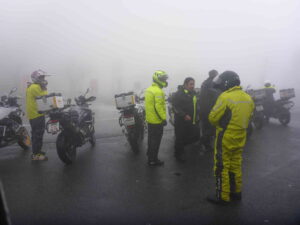
 I’m sure the sun shines in Vietnam. Sometimes. Just not when we’re there. Except for the first day after we entered from Laos, and our last morning before crossing into Cambodia, it’s varied between solid overcast and drizzling rain the whole time. It was much the same on our first swing through Vietnam. The good news is that it’s much cooler – comfortably mid-20’s along the coast and as cool as 12C in the mountains.

I have mixed feelings about Vietnam as a destination. It has a rich history and fascinating culture. The frenzy of Hanoi and other cities, the microcosms of the back alleys, all these are fascinating. And yet I also find it tiresome. For my taste, much of Vietnam is too crowded, too busy and too loud.
Much of our riding, south of Hanoi is along Asian Highway 1 – the main highway running the length of Vietnam. (AH1 actually runs 20,557 km from Tokyo to Istanbul). Like most major highways, it’s not that interesting, serving a mostly practical purpose. In densely populated Vietnam it is lined with towns and villages with scarcely any green space between – the Asian equivalent of strip malls.
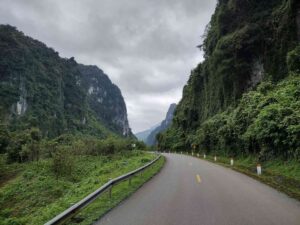 However when we do veer away from the highway Vietnam has some of the most gorgeous scenery and best riding we have encountered. The land is lush and green. Steep mountains rise from the rice paddies. The road curves along rushing rivers and snakes up into the mountains. It would be even better without the rain, but as I often say: there are two types of people in the world – those who want to be warm, safe and dry; and those who want to ride motorcycles.
We visit a few interesting sites along the way. The bridge over the Ben Hai River, that once marked the border between North and South Vietnam;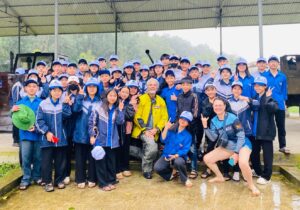 the Khu Ho Bom battle site, still scarred with bomb craters and displaying rusting bits of military hardware; the Vinh Moc tunnel complex where whole villages were moved underground. But my favorite moments are the more impromptu ones – the school group who wanted their picture with “the giant” (I’m as tall kneeling as most of them are standing); stopping for a few moments to watch a community soccer game; flying my kite on the beach at Cua Hoi (yes, I usually travel with a kite). And of course the fleeting encounters with people along the road, young and old alike, as briefly curious about me as I am about them.
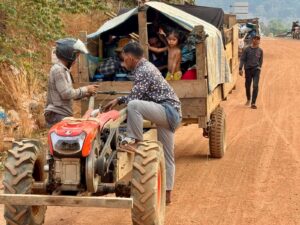 The transition into Cambodia is obvious. As we cross the Truong Son mountains, and descend from the central highlands of Vietnam, we leave the rain behind. The sun returns and so does the heat, climbing once again over 30C. Crossing into Cambodia is fairly routine. It takes about an hour to process the bikes and our visas. The work is done manually – hand written forms. That’s Cambodia. But after the hustle of Vietnam it’s nice to slow down.
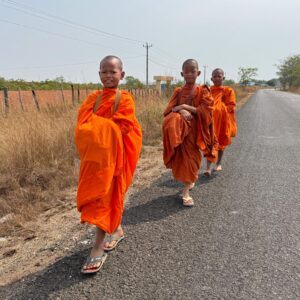 Cambodia is fairly flat. The rainy season hasn’t begun yet and the plains are brown, dry and dusty. Cambodia is also much poorer than it’s neighbours. But despite this, and it’s tragic recent history the people seem genuinely happier. I don’t think it’s just my perception. There are more smiles and there is more courtesy. I think it has something to do with the more relaxed pace of life. I feel more like a welcomed visitor, than a tourist commodity.
The roads are fairly straight and in good condition. The riding isn’t particularly challenging, but the countryside and little villages are an interesting landscape. It is the rural pulse of Cambodia and I am but a blip in its steady rhythm.
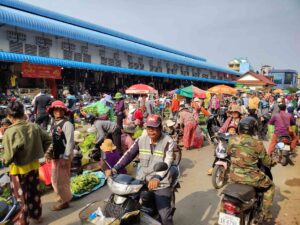 At Stung Treng we encounter the Mekong River once more and for the last time. We stay at a lovely resort with cabins along the river’s bank, watch the sun set and dine on fresh caught fish under the stars. The next morning we make a brief stop at the market in Stung Treng. Rice, fish, fresh produce, clothes, i-phones, scooter parts – it’s all for sale. It is a symphony of sound, smell, colour and humanity. It makes a trip to the supermarket seem very, very dull.
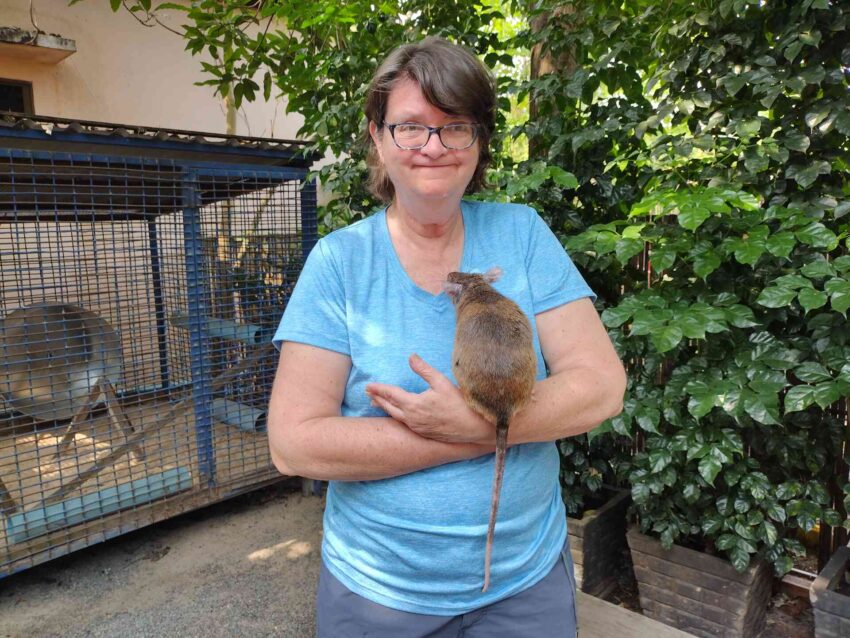
Our next destination is Siem Reap, home of Ankor Wat and its neighbouring temples. We visited the temples on our last tour, so we opt instead to spend some time with rats. Giant African pouched rats to be precise.
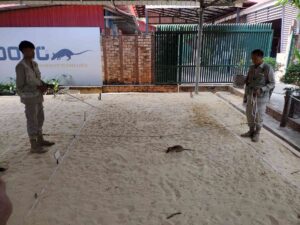 APOPO is an NGO that uses these very intelligent animals to sniff out landmines and other unexploded ordinance. This deadly debris has killed thousands of people in Cambodia and injured hundreds of thousands. The rats are able to smell TNT in one part per trillion but they are too light to trigger a mine. When they detect a mine or other device they scratch the surface. The spot is flagged and a de-mining specialist moves in to remove it. Working with their human handlers in a grid search, the rats are able to clear an area many times faster than a metal detector. We’re given a demonstration of how the rats are trained, then we’re given a chance to hold Gertrude, who is quite friendly and cute in a rodent sort of way.
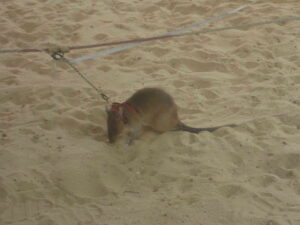 APOPO operates in Cambodia, and in many other conflict areas around the world. They also work with the victims of these brutal weapons, providing therapy and prosthetics. And they’re exploring other avenues, such as using the rats to detect TB, which they can also do many times faster than conventional testing. And for search & rescue, crawling into the tiny spaces in collapsed buildings. It’s a really positive and uplifting story in a country that has known more than it’s share of sorrow.
Our motorcycle trip is winding down. In a few more days, we’ll be flying home. I plan to write one final wrap up post. In the meantime, here’s the link to the photo gallery for this one.
Liz, you are so brave to hold unto the big rat. Elaine.
Liz, you are so brave to hold the big rat. Elaine.
Thanks for following along, Elaine. I’m glad you enjoyed it. Actually the rats are very sweet natured. They start socializing them to people when they are 4 weeks old.
Hi John and Liz, You know, Liz seems to have really bonded with Gertrude. Do you think there might be any opportunity for adoption? Who knows, there could be some interesting work for Gertrude out this way…
The thought briefly crossed our minds. They are well socialized, and I’ve known a couple of people that had regular rats. I think the size makes these a bit more attractive.
Your journey this winter has been a hi-light for me to read. I will not comment on the “rats” as I am certain you both will remember my visceral reaction to “mice” at your home 🙂
As always, thank you sincerely for taking time to include us in your journey. Hugs, Heather